Everyone is talking about collagen supplements. You’ve probably seen them at the pharmacy, in your Instagram feed, and even in your morning coffee routine. But here’s the real question most people are afraid to ask: Do collagen supplements work for skin, or is it just clever marketing?
The good news is that the science has gotten a lot clearer, especially over the past 12 months. So, in this guide, we’re going to break down exactly what the research says, which type of collagen is best for skin, how long it takes to see results, and what to look for when buying. No fluff. Just facts backed by science.
What Is Collagen, and Why Does Your Skin Need It?
Before we dive into supplements, let’s first understand what collagen actually is. Collagen is the most abundant protein in your body. Think of it as the scaffolding that holds your skin together it keeps your skin firm, smooth, and elastic.
Your body naturally produces collagen throughout your life. However, here’s where the problem starts: after your mid-20s, collagen production begins to drop by approximately 1 to 1.5% every single year. By the time you reach your 40s and 50s, the difference is very noticeable. Your skin starts to sag, fine lines appear more easily, and your complexion loses that youthful bounce.
On top of that, several lifestyle factors speed up this loss even further. Sun exposure, smoking, high sugar diets, and chronic stress all break down collagen faster than your body can replace it. So, by the time most people start thinking about collagen, their body is already running a significant deficit.
How Do Collagen Supplements Work?
This is where things get really interesting and also where a lot of confusion exists.
When you swallow a collagen supplement, your digestive system breaks it down into smaller amino acid fragments called collagen peptides. For a long time, scientists debated whether these peptides would actually reach the skin or simply get absorbed like any other protein.
However, more recent research has significantly changed that debate. Studies now show that specific collagen peptides, particularly hydroxyproline-containing dipeptides, are absorbed into the bloodstream after digestion and travel directly to the skin’s dermis layer. Once there, they stimulate your skin’s own fibroblast cells to produce more collagen naturally.
In other words, collagen supplements don’t just add collagen to your skin. More importantly, they signal your skin to start making more of its own. That’s a fundamentally different mechanism than, say, a topical cream — and it’s one of the reasons the research results are so encouraging.
Do Collagen Supplements Work for Skin? What Science Says
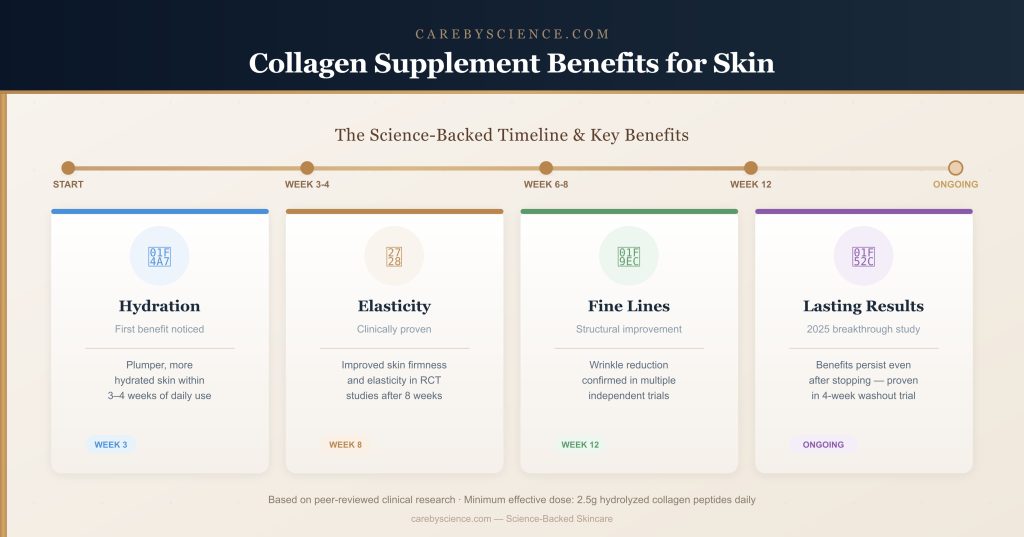
Let’s look at what real clinical studies have found because this is where carebyscience.com always goes first.
Study 1: Skin elasticity and hydration A well-cited randomized controlled trial found that women who took 2.5–5g of hydrolyzed collagen peptides daily for 8 weeks showed significant improvements in skin elasticity compared to those who took a placebo. Their skin also retained moisture more effectively, which directly reduces the appearance of fine lines.
Study 2: Long-term structural changes A 2025 randomized trial followed 77 participants who took 5,000mg of bioactive collagen peptides for 12 weeks. Here’s what made this study particularly exciting: even after participants stopped taking supplements during a 4-week washout period, the improvements in dermal density and hydration persisted. This suggests that collagen supplements may produce lasting structural changes in the skin — not just temporary results that disappear when you stop.
Study 3: Wrinkle reduction Multiple independent clinical trials have confirmed that oral collagen peptide supplementation reduced the appearance of wrinkles within 12 weeks of consistent use. Importantly, participants also noticed improvements in cellulite texture, which is closely related to collagen structure in the deeper skin layers.
So, to directly answer the original question: yes, collagen supplements can genuinely work for skin — when you choose the right type, the right dose, and take them consistently.
Marine vs Bovine Collagen: Which Is Best for Skin?
When you start shopping for collagen supplements, you’ll quickly run into two main types: marine collagen and bovine collagen. Understanding the difference is essential before you spend your money.
Marine Collagen comes from fish skin and scales. It is primarily Type I collagen, which happens to be the most abundant type in human skin. Because marine collagen peptides are generally smaller in size, they tend to absorb more easily into the bloodstream. For this reason, marine collagen is often specifically recommended for skin health and anti-aging purposes. If your primary goal is better skin, marine collagen is typically the stronger choice.
Bovine Collagen comes from cow hide and connective tissue. It provides a combination of Type I and Type III collagen, making it a more versatile option overall. Type III collagen is especially important for skin elasticity, gut lining health, and cardiovascular tissue. So, if you want a supplement that supports your whole body not just your skin bovine collagen offers broader coverage.
The bottom line? For pure skin benefits, marine collagen tends to edge ahead. However, for overall wellness plus skin benefits, bovine collagen is an excellent and usually more affordable choice.
How Long Does Collagen Take to Work?
Patience is genuinely required here and that’s something most supplement brands conveniently forget to mention.
Most people notice initial changes in skin hydration and texture within 4 to 6 weeks of daily use. However, more noticeable improvements in skin firmness, elasticity, and fine lines typically appear after 8 to 12 weeks of consistent supplementation.
Here’s a realistic timeline to keep in mind:
- Weeks 1–3: Your body adjusts and begins absorbing the peptides. You may notice slightly more hydrated skin, but visible changes are still subtle at this stage.
- Weeks 4–6: Skin texture often starts to feel smoother. Some people notice a slight improvement in plumpness.
- Weeks 8–12: Clinically meaningful improvements in elasticity, hydration, and fine line reduction become more visible for most people.
- Beyond 12 weeks: Results continue to build and deepen, especially if you maintain a consistent daily routine.
The key is consistency. Taking collagen occasionally or skipping days significantly reduces the cumulative benefit. Think of it less like a medicine and more like a daily investment in your skin’s foundation.
What to Look for When Buying a Collagen Supplement
Not all collagen supplements are created equal. The market is unfortunately flooded with products that are underdosed, poorly processed, or misleadingly labeled. Here’s exactly what to check before you buy:
1. Hydrolyzed Collagen Peptides Always look for the term “hydrolyzed” on the label. This means the collagen has been broken down into smaller peptides, which makes it significantly easier for your gut to absorb. Non-hydrolyzed collagen is much harder to digest and unlikely to deliver strong results.
2. Effective Daily Dose Research consistently points to a minimum of 2,500mg (2.5g) per day for skin benefits, with most studies using doses between 5,000mg and 10,000mg for more significant results. Be very wary of products that hide their collagen content inside a “proprietary blend” without telling you the exact amount.
3. Type I or Type I + III Collagen For skin health specifically, prioritize products featuring Type I collagen the type that directly supports skin structure, hydration, and elasticity.
4. Added Vitamin C This is a bonus ingredient worth actively seeking out. Vitamin C is essential for collagen synthesis in your body. Without adequate vitamin C, your fibroblast cells cannot efficiently produce new collagen even when stimulated by peptide supplementation. Many quality collagen products include vitamin C for precisely this reason.
5. Third-Party Testing Especially for marine-sourced collagen, look for products that have been independently tested for heavy metals and contaminants. Reputable brands will display certifications from organizations like NSF, Informed Sport, or USP.
Best Ways to Take Collagen for Maximum Results
Taking collagen is simple, but a few smart habits can meaningfully improve how well it works for you.
Timing: While collagen can technically be taken at any time of day, many nutritionists suggest taking it in the morning — either on an empty stomach or with breakfast. Some evidence suggests that collagen peptides may be absorbed slightly more efficiently when taken away from heavy protein meals, though this is not yet definitively proven.
With Vitamin C: As mentioned above, pairing your collagen with a source of vitamin C whether it’s a supplement, fresh orange juice, or a vitamin C-rich smoothie can actively support the collagen synthesis process.
Consistent Daily Use: This point cannot be overstated. Collagen supplementation works cumulatively. Skipping days resets the process. Build it into a daily habit the same way you would a skincare step.
Powder vs. Capsule vs. Liquid: Powder forms tend to offer the highest doses and best flexibility. Capsules are convenient but often contain smaller doses. Liquid collagen supplements are increasingly popular because of their potentially faster absorption, though they tend to be more expensive.
Does Topical Collagen Work Too?
This is a really common question and it’s worth addressing clearly. The answer is largely no, not in the same way.
Collagen molecules are too large to penetrate through the outer layers of your skin on their own. When you apply a “collagen cream” or “collagen serum” to your face, the collagen itself sits on the surface and acts more as a temporary moisturizer than a structural rebuilder. It cannot reach the dermis layer where collagen is actually produced.
That said, some topical skincare ingredients do stimulate collagen production from the outside in most notably retinoids (retinol), vitamin C serums, peptides, and niacinamide. So, the most science-backed approach is to combine topical collagen-boosting ingredients with oral collagen supplementation. Together, they cover both pathways: from the outside and from the inside.
Who Benefits the Most from Collagen Supplements?
While collagen supplements can benefit most people over time, certain groups tend to see the most noticeable results.
Women over 30 are probably the most well-studied group. Because collagen loss accelerates around perimenopause due to declining estrogen levels, women in their 30s, 40s, and 50s often experience some of the most dramatic skin improvements from supplementation.
People with naturally dry or dehydrated skin often notice faster improvements in hydration and plumpness, sometimes within just a few weeks.
Anyone with a poor diet particularly low protein intake, low vitamin C, or high sugar consumption, is likely starting from a significantly depleted collagen baseline. In these cases, supplementation can make a very visible difference.
Active individuals and athletes also benefit, as intense exercise generates oxidative stress that can accelerate collagen breakdown in both the skin and joints.
Collagen and Your Overall Wellness Routine
One of the things we love about collagen at Care by Science is that it doesn’t exist in isolation. Your skin’s collagen levels are deeply connected to many other aspects of your health including your gut microbiome, your sleep quality, your stress hormone levels, and your nutritional status.
For example, chronic high cortisol levels (a common result of ongoing stress) actively break down collagen in the skin. Simultaneously, poor sleep reduces growth hormone secretion overnight and growth hormone is one of the key signals that drives collagen repair and regeneration while you rest.
This means that collagen supplementation works best as part of a broader approach to skin health. Pairing it with good sleep, stress management, a nutrient-rich diet, and a smart topical skincare routine will always yield better results than supplementation alone.
Final Thoughts: Is Collagen Worth It?
Based on the current body of clinical research and especially the newer 2025 studies showing persistent structural improvements collagen supplements are one of the more evidence-backed internal wellness choices available for skin health today.
They’re not a miracle. They’re not going to reverse decades of sun damage overnight. However, when you choose a quality hydrolyzed product, take an effective dose consistently, and combine it with smart skincare habits, the research genuinely supports meaningful improvements in skin hydration, elasticity, and the reduction of fine lines over time.
If you’re already investing in a good skincare routine on the outside, then supporting your skin from the inside with collagen is a logical and science-backed next step.

Tamanna Zaman is an English graduate and self-care researcher at CareByScience, creating research-driven content on skincare, haircare, and wellness. By analyzing clinical studies and verified expert insights, she provides actionable, trustworthy routines that help readers achieve healthier skin, stronger hair, and overall wellbeing.