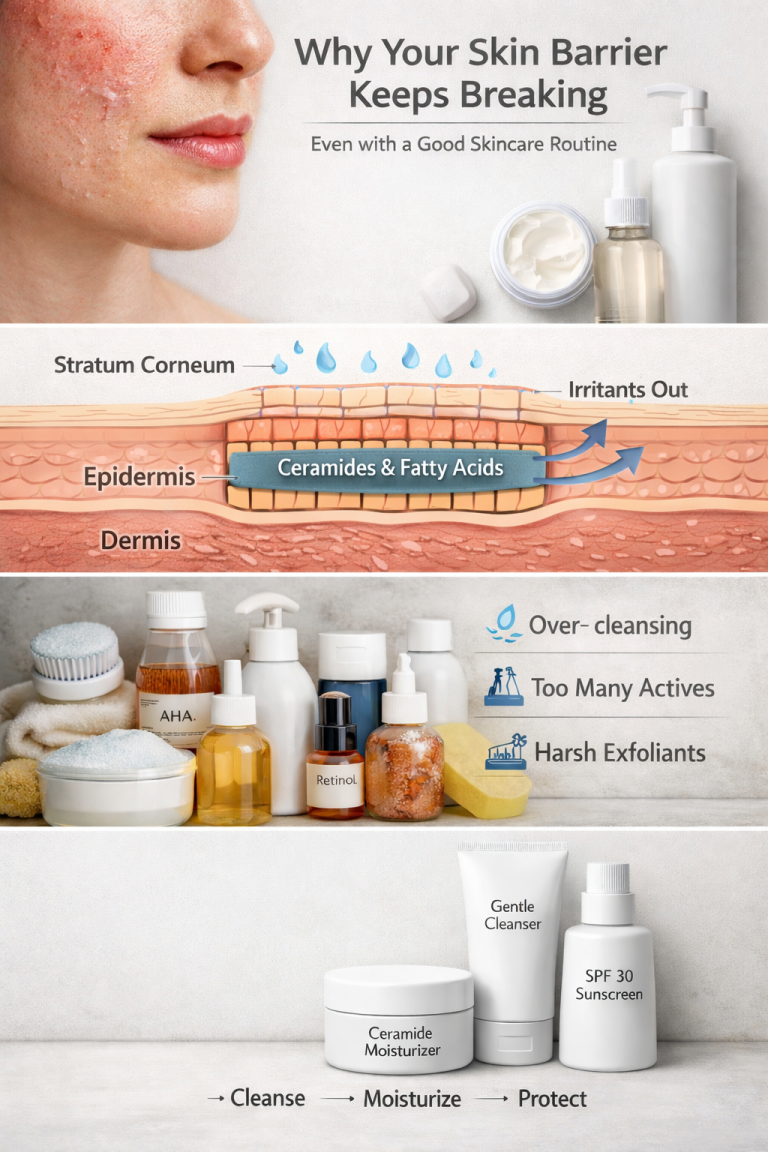
You apply a thick layer of moisturizer in the morning. By noon, your face feels tight, itchy, and dull. You drink more water, you buy expensive serums, but the dryness returns. The problem likely isn’t your product—it’s a biological process called Transepidermal Water Loss (TEWL).
In the world of dermatology, hydration isn’t just about putting water on the skin; it is about keeping water in the skin. When the mechanisms that trap moisture fail, evaporation takes over. In this deep dive, we will decode the science of TEWL, learn how to spot it, and identify the exact ingredient hierarchy needed to repair a leaky skin barrier.
Key Takeaways
- TEWL definition: It is the passive evaporation of water from the deep layers of your skin into the atmosphere.
- The Winter Spike: Low humidity creates a “vapor pressure gradient” that literally pulls water out of your skin.
- The Solution: Hydration requires a three-step structure: Humectants to grab water, Emollients to smooth the barrier, and Occlusives to lock it in.
- Myth Buster: Drinking water alone cannot repair a damaged skin barrier, even if your TEWL is high.
What is Transepidermal Water Loss (TEWL)?
To understand TEWL, you have to visualize your skin as a container.
Your skin is composed of multiple layers. The outermost layer, the Stratum Corneum, acts as the lid of the container. In a healthy state, this lid is tight, keeping water inside the body and keeping bacteria out. This is your Skin Barrier.
Transepidermal Water Loss is the amount of water that passively passes from the deeper, hydrated layers of your skin (the dermis), moves up through the epidermis, and evaporates from the surface into the air.
Is TEWL Bad?
Not entirely. Some water loss is a normal physiological process. However, when your skin barrier is damaged—due to harsh weather, over-exfoliation, or aging—the “lid” of the container develops cracks.
According to research in the Journal of Clinical Medicine, elevated TEWL is a primary marker of barrier disruption, often linked to conditions like atopic dermatitis and severe xerosis (dry skin).
CHECKLIST: 3 Signs Your Skin Has High TEWL
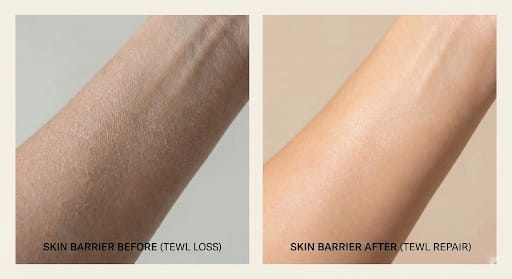
(If you experience these, your barrier is likely leaking water)
- The “Disappearing Act”: Your moisturizer absorbs instantly, but your skin feels dry again within 1 hour.
- The “Tightness” Test: Your skin feels physically tight or “too small” for your face immediately after cleansing.
- The Sting: Gentle products or simple water cause a mild burning or stinging sensation (a sign of microscopic cracks).
The Physics of Winter: Why Central Heating Destroys Your Skin
Why is TEWL worse in January than in July? It comes down to basic physics: Osmosis and Vapor Pressure.
Water naturally moves from areas of high concentration to areas of low concentration to find balance.
- In Summer: The air is humid (full of water). The difference between the water in your skin and the water in the air is minimal. TEWL is low.
- In Winter: The air outside is dry. Inside your home, central heating strips the remaining moisture, dropping humidity levels to desert-like conditions (often below 30%).
Because the air is so “thirsty,” it acts like a magnet, aggressively pulling water molecules out of your skin to balance the atmosphere. This is why a lightweight lotion that worked in summer fails in winter—it cannot withstand the atmospheric pull.
The Solution: The Moisture Sandwich Method
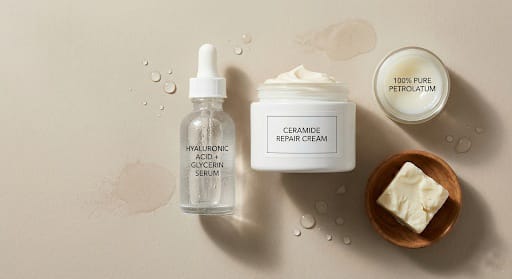
To stop High TEWL, you cannot simply apply “moisture.” You must mimic the skin’s natural barrier structure. A scientifically sound routine must include three categories of ingredients working in synergy.
1. Humectants (The Water Magnets)
Humectants are hygroscopic substances that attract water from the deeper layers of the skin or the environment.
- Key Ingredients: Glycerin, Hyaluronic Acid, Panthenol (Vitamin B5), Urea.
- The Catch: In dry winter weather, if you apply only a humectant (like a pure Hyaluronic Acid serum) without sealing it, it can actually increase TEWL by drawing water up to the surface, where it quickly evaporates.
2. Emollients (The Barrier Support)
Emollients are lipids (fats) that fill the gaps between your skin cells, much like mortar between bricks. They make the skin feel soft and repair the cracks in the barrier.
- Key Ingredients: Ceramides, Cholesterol, Fatty Acids, Squalane.
- Why You Need Them: They repair the “lid” of the container so water has a harder time escaping.
3. Occlusives (The Seal)
This is the most critical step for stopping TEWL. Occlusives form a hydrophobic (water-repelling) film on top of the skin that physically blocks evaporation.
- Key Ingredients: Petrolatum (Vaseline), Dimethicone (Silicones), Shea Butter, Mineral Oil.
- The Data: Clinical studies have established that petrolatum reduces TEWL by up to 99%, making it the gold standard occlusive in dermatology for barrier repair.
Editor’s Note: Many luxury creams lack sufficient occlusives. If you have severe dryness, applying a thin layer of an ointment (like Vaseline or CeraVe Healing Ointment) as the final step at night—a practice known as “slugging”—is the most effective way to halt TEWL.
Winter Skincare Routine to Lower Transepidermal Water Loss
If your skin feels tight and dehydrated, switch to this repair-focused routine for 2 weeks.
Step 1: Cleanse with Care
Stop using foaming cleansers that leave your skin “squeaky clean.” Squeaky means you have stripped your natural lipids. Use a milky or creamy cleanser.
Step 2: Hydrate on Damp Skin
Apply your toner or Hyaluronic Acid serum while your face is still slightly damp from washing. This gives the humectants free water to bind to.
Step 3: The Barrier Cream
Look for a moisturizer containing Ceramides. These mimic the skin’s natural structure. (This same logic applies to your hair—read more about maintaining a healthy scalp barrier here.
Step 4: The Seal (Night Only)
If you are struggling with flaky patches, apply a pea-sized amount of a petrolatum-based balm over your moisturizer to lock everything in.
Internal Wellness: Can You Drink Your Way to Hydrated Skin?
A common myth is that drinking 3 liters of water a day will cure dry skin.
While systemic dehydration is dangerous, clinical studies show that drinking extra water has a minimal effect on the skin’s surface hydration unless you were severely dehydrated to begin with.
The water you drink goes to your vital organs first (brain, heart, kidneys). Your skin gets the leftovers. To improve your skin’s ability to hold water from the inside, focus on Omega-3 Fatty Acids (found in fish oil, flaxseeds, and walnuts). These healthy fats help strengthen the cell membranes, improving the skin’s lipid barrier naturally.
Conclusion
Transepidermal Water Loss is not a disease; it is a signal. It is your skin telling you that its barrier is compromised and it cannot defend itself against the environment.
By understanding the science of ingredients—using humectants to hydrate and occlusives to seal—you can manipulate the process. You don’t need a miracle product; you simply need to respect the biology of your barrier.
No.
Dry Skin is a skin type that lacks oil (lipids).
Dehydrated Skin is a condition caused by high TEWL, meaning it lacks water. Even oily skin can be dehydrated!
It can. In very dry climates (low humidity), Hyaluronic Acid may pull water out of your skin if there is no moisture in the air. Always follow it with a cream to seal it in.
With a gentle routine focused on lowering TEWL, a healthy skin barrier can repair itself significantly within 2 to 4 weeks.

Tamanna Zaman is an English graduate and self-care researcher at CareByScience, creating research-driven content on skincare, haircare, and wellness. By analyzing clinical studies and verified expert insights, she provides actionable, trustworthy routines that help readers achieve healthier skin, stronger hair, and overall wellbeing.